

7 Ways Flip'n Fit Works Kids' Brains as Hard as Their Bodies
By the Flip'n Fit family · November 1, 2026
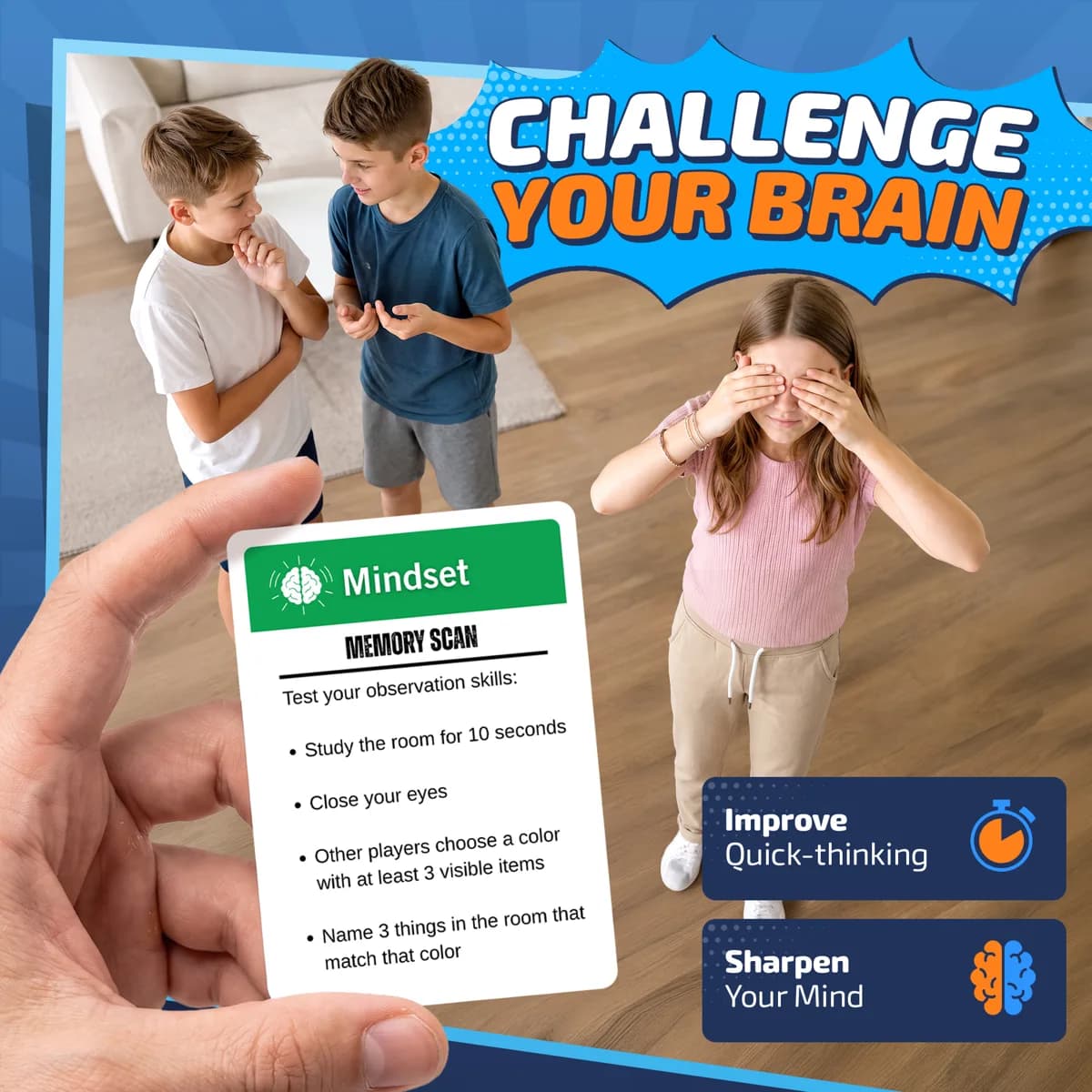
Most fitness games stop at reps. When we designed Flip'n Fit, we wanted every flip to be a decision too: what to play, when to push, and how to stay calm when the game turns against you.
That's why the deck has a whole Mindset category alongside Leg Day, Core Crush, and Armory, plus Energy Boost and Setback cards that keep everyone thinking. Here are seven ways the game works the brain, card by card.
1. Memory Scan: notice everything
The Memory Scan card asks players to study the room for 10 seconds, close their eyes, and then name three things that match a color the other players choose. Kids quickly learn to look more carefully the next time it comes up.
2. Focus Freeze: stillness is a skill
Balance on one foot, stay completely silent, and keep your eyes forward for 15 seconds per foot. It sounds easy until three other people are watching. Focus Freeze turns concentration into a challenge kids actually want to win.
3. Self Control: the straight-face test
Look at another player, no smiling, no laughing, for 10 seconds. Everyone watching will probably try to make you laugh. It’s the most laughter per card in the deck, and it’s real practice at staying composed.
4. 5-4-3-2-1: a reset in the middle of the action
Name 5 things you can see, 4 you can touch, 3 you can hear, 2 you can smell, and 1 you can taste. After a round of jump squats and planks, this card slows everyone down and brings attention back to the room.
5. Brain Freeze: think fast under pressure
Brain Freeze is a Setback card: in 15 seconds, name 5 animals, 5 fruits, and 5 colors. Miss, and you return a completed card to the deck. A little time pressure makes simple questions surprisingly hard. That’s the point.
6. Energy Boosts: strategy, not just luck
Do you play Cheat Day now to skip a tough exercise, or save it? Use Double Trouble to make an opponent's next exercise harder? Swap cards with Switcheroo? 2 for 1 even makes you choose between two cards on the spot. Kids start planning a few turns ahead without being told to.
7. Pick your level, and try again
Every exercise card has Beginner, Intermediate, and Advanced options, so players choose a challenge that fits them. If you can't finish an exercise, the card goes to the bottom of the deck. No elimination, no sitting out: you just get another chance later. It's a gentle way to practice picking yourself back up.
Put it all together and a 15-minute round has kids moving, remembering, strategizing, and laughing, often all in the same turn. That's what we mean by healthy bodies, healthy minds.